In this conversation M HKA’s Senior Curator Anders Kreuger and futurist Maya Van Leemput of the centre for Applied Futures Research | Open Time compare notes on what made the exhibition and the conference happen.
If you were with us for DDT, you will recognise the four alternative futures, the installations and the activities. If you couldn’t join us, this short video will provide some insight into the whole set-up and why we all enjoyed it so much.
Ahead of the third Antwerp Art Weekend, a guide to the best shows across the city. By Antony Hudek
‘A Temporary Future Studies’, 2017, installation view, M HKA, Antwerp. Courtesy: M HKA, Antwerp
A Temporary Futures Institute M HKA 28 April – 17 September 2017
The Museum of Contemporary Art Antwerp, M HKA, has just undergone a thorough revamp, with a ground floor interior redesigned by architect Tatsuro Miki and interior designer Axel Vervoordt. New spaces for the permanent collection, an Artists’ Archive Centre and a public reading area make the museum into a much more intimate, cosier, even, place. On the first floor, cosy is probably the last word that comes to mind: in the exhibition ‘A Temporary Futures Institute’, co-curators Anders Kreuger and Maya Van Leemput conjure up a sometimes retro-poetic (Michel Auder, Miriam Bäckström) at other times techno-predictive (Simryn Gill, Mei-Mei Song) overview of what awaits us in an indeterminate future. For the Antwerp Art Weekend, on Saturday 20 May, Kreuger and Van Leemput host a workshop around the theme of ‘diversity’, which promises to make the future feel like a stone’s throw away.
From 27 April until 17 September 2017 M HKA – Museum of Contemporary Art Antwerp is hosting an exhibition that intends to be ‘more than an exhibition’.
A Temporary Futures Institute turns the museum into a laboratory or studio, brings together two contexts that have certain things in common: art and futures studies.
The co-organisers are M HKA’s senior curator Anders Kreuger and Antwerp-based professional futurist Maya Van Leemput.
Both artists and professional futurists have been invited (from the sub-fields of Alternative Futures, Design Futures, Postnormal Futures and Technology Futures) to contribute to and participate in a common project.
All contributors in A Temporary Futures Institute are asked to address either continuation (or continued growth), collapse (in itself but also as a possible beginning of something new), discipline (whether top-down, as in authoritarian societies, or bottom-up, as in activist movements) and transformation (with special attention to possible future roles of Artificial Intelligence).
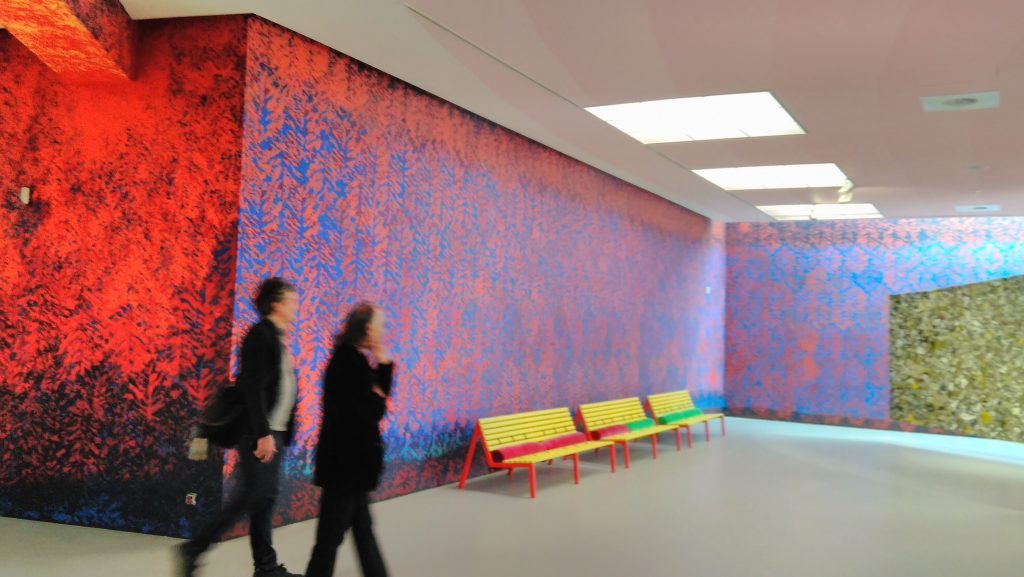
Each futures scenario is addressed by at least one artist and one non-artist, and the exhibition is organized as discrete units, enveloped by a purpose-built set commissioned from the artist Alexander Lee (1974, French Polynesia).
The other invited artists are: Nina Roos (1956, Finland) and Darius Žiūra (1968, Lithuania) for ‘continuation’; Michel Auder (1944, France/US) and Simryn Gill (1959, Malaysia/Australia) for ‘collapse’; Miriam Bäckström (1967, Sweden) and Kasper Bosmans (1990, Belgium) for ‘discipline’; Guan Xiao (1983, China) and Jean Katambayi (1974, Democratic Republic of the Congo) for ‘transformation’.
Maya Van Leemput (1969, Belgium) has also contributed to the exhibition, for ‘continuation’.
The professional futurists invited are: Meimei Song (1966 Taiwan) for ‘collapse’; Centre for Postnormal Policy and Futures Studies (London/Chicago), consisting of Ziauddin Sardar (1951, Pakistan/UK) and John Sweeney (1977, US) for ‘discipline’; Stuart Candy (1980, Australia/Canada) for ‘transformation’.
Image Credits: M HKA, A Temporary Futures Institute, Installation View M HKA – Museum of Modern Art Antwerp, Belgium
Following intense renovations by architects Axel Vervoordt and Tatsuro Mikki, the Museum of Contemporary Art opened its doors with the experimental exhibition A Temporary Futures Institute.
Turning the institute into a laboratory-cum-studio, it fuses art and future studies under the umbrella project The Uses of Art by the European museum confederation L’Internationale. Instead of living in a retrospective or nostalgic reality, the exhibition invites viewers to think critically about what is yet to come and to adopt the practice of ‘foresight’ (forward thinking). A means to holistic thinking and understanding process as opposed to a fast-forward method towards an answer or defined knowledge, “the plural is important; it reminds us not to try to predict one single future,” the exhibition statement explains.
The show is formulated around the “four futures” concept professor Jim Dator presented in the 1960s as a way to explain the way in which the future is envisioned through the terms “continued growth”, “collapse”, “discipline” and “transformation”. These keywords form the foundation for sub-themes within the show, alongside a visual aid created by Alexander Lee, whose dynamic paintings and installations introduce the exhibition. Curators Anders Kreuger and Dr Maya Van Leemput then pose additional questions such as “How shall exhibitions stimulate our thinking? Must they become immersive environments to lure us away from our screens?” and “How autonomous will exhibitions, and the art and artists they feature, be in relation to the rest of the world?” Artists and academics Michel Auder, Miriam Bäckström, Kasper Bosmans, Simryn Gill, Guan Xiao, Jean Katambayi Mukendi, Alexander Lee, Nina Roos and Darius Žiūra work to metaphorically interpret and critique existing and stereotyped ideas of the future with a touch of fantasy and an uncomfortable dose of reality.
Here are six ominous interpretations not to miss.
The London-based Center for Postnormal Policy & Futures Studies is represented by director Professor Ziauddin Sardar and deputy director John A. Sweeney’s installation Postnormal Times (2017). It predicts futures characterised by “Contradiction, Complexity and Chaos”, where all that was ‘normal’ has evaporated. A sub-work, Polylogue (2017), comes in the form of a game, which upon collapse demonstrates the uplifting potential for new beginnings.
Michel Auder’s observations of the ups and downs of metropolitan life since the 1960s comes forward in 1967 (1967-2017), a nine-channel video installation based on silent film footage. Harking back to the optimism of 50 years ago, the installation dichotomously features three videos that offer deep insight into the American psyche that prefigure 9/11 and Trump: It’s Hard to Be Down When You’re Up (1978-2005), shot at New York’s World Trade Center; Voyage to the Center of the Phone Lines (1993), eavesdropping on mobile phone conversations; and Mixing Up the Medicine (2015), a free-form essay film.
Mei-Mei Song, assistant professor at the Graduate Institute of Futures Studies, Tamkang University, Taipei, presents a technology-assisted pricing system for consumer goods in an imagined highly disciplined society, where items for sale are valued in euros and Carbon Footprint Points – work is a privilege to be paid for. Additional work Time Machine (2017) is a role-play exercise instructing participants to ‘look back before looking forward’.
Miriam Bäckström shows four tapestries from the series New Enter Image (2016–ongoing) where the works, based on multiple high-definition digital photographs of textiles and everyday objects woven onto computerised jacquard, articulate the impossibility of central perspective in digital reality, suggesting instead that we are already in the image, inextricably entwined in it.
Dr Stuart Candy, who defines himself as a professional futurist and experience designer, creates the installation NurturePod (2017), which highlights society’s increasing and unavoidable dependence on information systems by fitting out an infant with a headset.
Guan Xiao’s video triptych DengueDengueDengue (2017) features footage from the technology-obsessed and reliant modern day transformed into a “panchronic” reality where the past, present and future attack society simultaneously.
Temporary Futures Institute runs until 17 September at the Museum of Contemporary Art, Antwerp, Belgium. For more information visit muhka.be
It’s unpronounceable, its director says it’s an alternative to the Tate, and it’s just had a makeover by two of Belgium’s leading resident designers, one Flemish and the other Japanese. Welcome to M HKA, the institution that is restoring modern art to the list of what makes Antwerp one of Europe’s coolest cities.
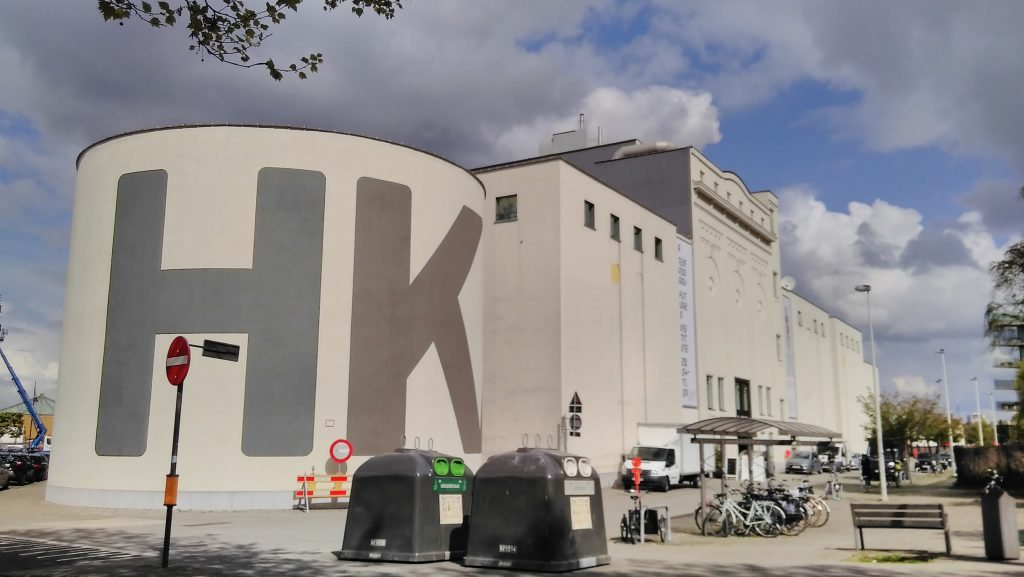
First, about those initials. The Museum of Modern Art Antwerp had been abbreviated to MuKHA but in 2002 artist Christophe Terlinden proposed dropping the ‘u’. It was a repudiation of acronyms like MOMA, MOCA etc. On a drum-shaped corner of the building, once a granary on the Schelde riverside, he painted the letters HK three storeys high.
M HKA occupies an ex-granary building and is counter-branded by the big letters of Christophe Terlinden’s The Missing U (2002). Photo Herbert Wright
The building may be clearly labelled outside, but the clarity didn’t extend inside. Designer Axel Vervoordt said ‘it was a little chaotic when we saw the plans of the old buildings, it was quite a mess’. He and Tatsuro Miki, an architect who’s been in Belgium 25 years, have tackled the heart of the problem – the ground floor. Now, the reception and ticket desk are in a large central space called the Reading Room. It’s lined with shelves not just stacked with books but curiosities including art and maquettes. It’s a warm, welcoming environment in which everything, including an eight metre long reading table that stretches through it, is now in wood.
M HKA’s new Reading Room with front desk, in the revamp by Axel Vervoordt and Tatsuro Miki. Photo M HKA
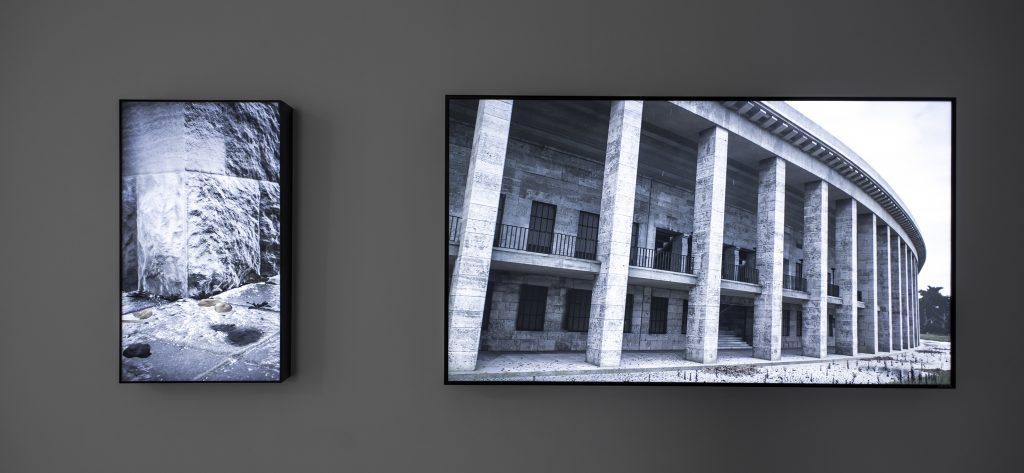
A triangular space leads off from the Reading Room, bare but for a remarkable commissioned work – Belgian artist David Claerbout’s Olympia (the real time disintegration into ruins of the Berlin Olympic Stadium over the course of a thousand years, start 2016) which is real-time colour HD computer simulation that moves slowly through what the title says. This is a meditative work about time, architecture and decay, in execution and ambition comparable to the simulations of John Gerrard (whose X. laevis (Spacelab) you can see in London at the Wellcome’s Electricity show until 25 June).
David Claerbout’s simulation Olympia (2016). Photo M HKA
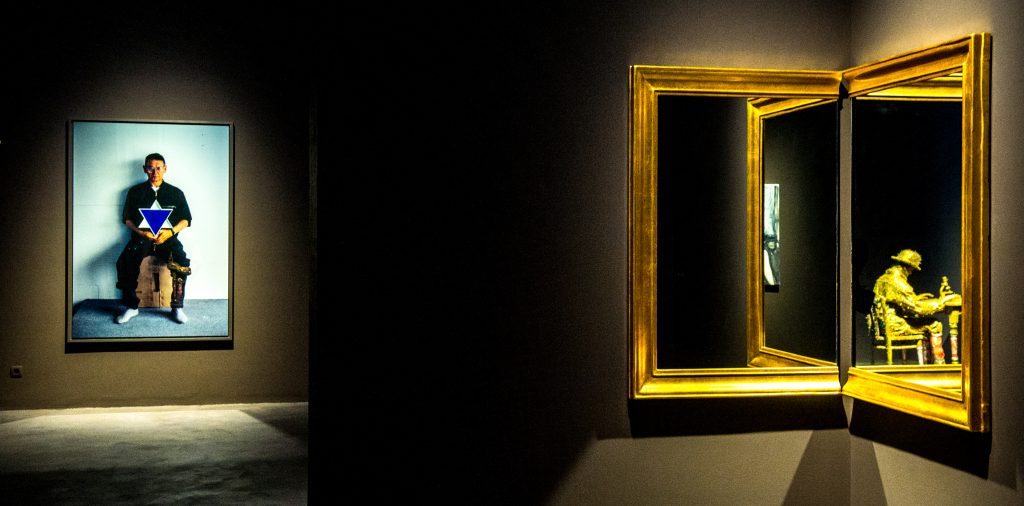
The triangular space is also the pivot around which Vervoordt and Tatsuro tackled a suite of galleries that are crucial to M HKA’s new presentation. ‘We saw the hidden proportions’ says Vervoordt – the rooms on each side of it are a circle, a golden-section rectangle, and a square. The rectangle hosts a gentle reflection on Russian cultural themes by Evgeny Antufiev, facilitated by the V_A_C Foundation, Moscow. It is the square that showcases the best of M HKA’s permanent collection, and the space is black and partitioned. Tatsuro talks about how ‘dark is associated with the night, you are alone, you go into yourself. The art comes out of the space’. It’s not a huge collection, but there are several must-sees, including Jan Fabre’s iconic drawing pin-studded man at a table, Ik, aan het dromen (I’m dreaming) (1979), Jimmie Durham’s Jesus, es geht um die Wurst (Jesus, it’s about the sausage) (1992) and a beautiful Flemish village painting by local master Luc Tuymans.
Works by Jeff Geys, Michelangelo Pistoletto and (reflected) Jan Fabre, in the new gallery. Photo M HKA
Elsewhere, M HKA’s exhibition spaces are as they were, on various floors.
Detail: Peter Wächler’s Romulus. Photo Herbert Wright
The other wing of the ground floor is an airy double-height wedge called In Situ, hosting (until 3 September) the installation Romulus, a commissioned work by German artist Peter Wächtler who lives in Antwerp. It’s an introspective yet expansive work, with clay castles, red paintings, and on the floor, sleeping dogs made of leather that look a bit like flayed penises.
Upstairs, the project A Temporary Futures Institute (until 17 September) has an extensive, wonderfully diverse spread of works. For example, the futurists Agence Future present the names of key names and titles from sci-fi (you’ll find George Orwell, Arthur C Clarke and Kubrik, for example) and futurology (including RAND Corporation, Herman Kahn, Frederik Polak etc) on columns across the floor as well as a wall of videos. What a contrast with the stunningly lush and vibrant walls painted by Polynesian artist Lee Alexander, which is called Te fanau’a ‘una’una na? te Tumu: The Sentinels.
Walls by Lee Alexander, from Te fanau’a ‘una’una na? te Tumu: The Sentinels. Photo Herbert Wright
There is yet more, not least Belgium’s only Skyspace by James Turrel (one of his hallmark skylight rooms) up at the top. And on the fourth floor, the M HKAFE (yes, a café) opens onto rooftop terraces either side with wonderful views across the Antwerp roofscape, some framed by empty window frames left from the facades of the original building.
But what about that claim, from M HKA director Bart de Baere, that ‘we are the only alternative to The Tate’? He’s talking about a model for bringing modern art to a broad audience and he has an alternative to the mega-gallery. M HKA is a member of the EU-supported L’internationale, a constellation of nationally significant galleries such as MG+MSUM in Ljubljana, Slovenia and MNCARS, Madrid, and associate partners. The model, de Baere explains, is ’medium spaces – we exchange the content’. With six core members, it has a base, but there’s some way to go before it can have the depth and sheer power of Tate, MoMA or the Pompidou.
Does it matter? M HKA have a unique collection, curatorial programming that has flair, and a great building. Accessing it and the art has now become an experience in itself, thanks to those new, sublime spaces.
In the spring and summer of 2017, M HKA will host an exhibition that intends to be ‘more than an exhibition’. ‘A Temporary Futures Institute’ will attempt to turn the museum into a laboratory or studio, and to bring together two contexts that have certain things in common: art and futures studies (also known as foresight).
The initial impulse of the co-organisers, M HKA’s senior curator Anders Kreuger and Antwerp-based professional futurist Maya Van Leemput, was to compare their two speculative domains. Perhaps they are disciplines, perhaps not. How do art and futures studies relate to knowledge? In art, the concept and practice of knowing is always contested: sometimes under-rated, sometimes over-rated, often in conflict with thinking and feeling. In futures studies, the desired object of knowledge – the various futures that might be – is per definition always absent, because it doesn’t yet exist.
Since we want to challenge the museum presentation format, we thought it would be useful to invite both artists and professional futurists (with specialisations in Alternative Futures, Design Futures, Postnormal Futures and Technology Futures) to contribute to and participate in a common project for a few months. Therefore the title: ‘A Temporary Futures Institute’.
From a curatorial perspective it is interesting to work with futures as an exhibition theme and to consider the futures of exhibition-making itself. From a futurist perspective this is a valuable opportunity to see how artists can create and communicate images of futures and help question the meanings and methods of futures studies.
As a structuring device for the exhibition, we decided to use an approach originating at the Manoa School of Futures Studies at the University of Hawaii in Honolulu where professor em. James Dator developed an analytical and scenario modelling tool that he calls ‘four futures’.
All contributors in ‘A Temporary Futures Institute’ are asked to address either continuation (or continued growth), collapse (in itself but also as a possible beginning of something new), discipline (whether top-down, as in authoritarian societies, or bottom-up, as in activist movements) and transformation (with special attention to possible future roles of Artificial Intelligence).
The intention is to ensure that each futures scenario is addressed by at least one artist and one non-artist, and to organise the exhibition as discrete units, enveloped by a purpose-built set commissioned from the artist Alexander Lee (1974, French Polynesia).
The other invited artists are: Nina Roos (1956,Finland) and Darius Žiūra (1968, Lithuania) for ‘continuation’; Michel Auder (1944, France/US), Simryn Gill (1959, Malaysia/Australia) for ‘collapse’; Miriam Bäckström (1967, Sweden) and Kasper Bosmans (1990, Belgium) for ‘discipline’; Guan Xiao (1983, China) and Jean Katambayi (1974, Democratic Republic of the Congo) for ‘transformation’.
Maya Van Leemput (1969, Belgium) is also contributing to the exhibition, for ‘continuation’. The professional futurists invited are: Mei-Mei Song (1966 Taiwan) for ‘collapse’; Centre for Postnormal Policy and Futures Studies (London/Chicago), consisting of Ziauddin Sardar (1951, Pakistan/UK) and John Sweeney (1977, US) for ‘discipline’; Stuart Candy (1980, Australia/Canada) for ‘transformation’.
The museum’s mediation team has been involved from the beginning in devising the content and form of the project. Our aim is to attract audiences that are different (and hopefully broader) than M HKA’s usual followers. We are hoping to involve a variety of groups and organisations in creating activities inside and during the exhibition, encouraging visitors to come more than once.
The DDT unconference will be held on Friday June 16th and Saturday June 17th inside the exhibition.
‘A Temporary Futures Institute’ will open at the end of April 2017 and run until the end of September. The project is part of the series ‘The Uses of Art’, funded by the European Union through the L’Internationale museum confederacy, of which M HKA is a founding member. Other members of the confederacy include MACBA in Barcelona, Moderna Galerija in Ljubljana, Reina Sofía in Madrid, SALT in Istanbul and Ankara and the Van Abbemuseum in Eindhoven.


 ‘A Temporary Future Studies’, 2017, installation view, M HKA, Antwerp. Courtesy: M HKA, Antwerp
 M HKA – Museum of Modern Art Antwerp, Belgium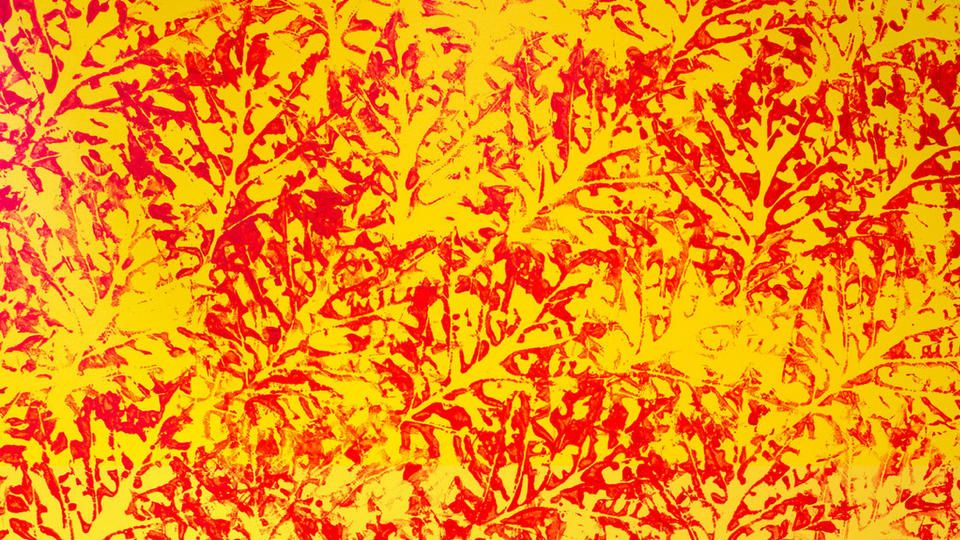


 Design Develop Transform